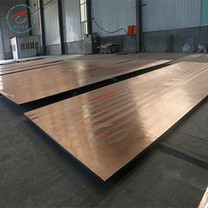
GB/T 8165-2025,the national standard for stainless steel clad steel plates and strips,was officially implemented on January 1, 2026.Together with NB/T 47002.3-2019 for pressure vessel titanium-steel clad plates and NB/T 47013.15-2021 for phased array ultrasonic testing,it has comprehensively tightened inspection specifications for titanium and nickel-based pressure-bearing clad plates,greatly lifting the industry's quality and access thresholds.
Current specifications require 100% full-area ultrasonic scanning for all pressure-vessel-grade titanium clad plates.GB/T 8165-2025 further mandates full-plate ultrasonic inspection for all pressure-bearing clad plates with a base thickness over 4mm.In modern refining,offshore and chemical project bidding,phased array ultrasonic testing (PAUT) has widely replaced conventional manual ultrasonic testing as the preferred inspection method.
Strict requirements are enforced on interfacial bonding performance.Substandard clad plates are forbidden for use in core pressure equipment including filters,heat exchangers and chemical reactors.Inferior products that only adopt partial sampling inspection are gradually phased out of the high-end engineering market.
Clad plates manufactured with backward processes commonly suffer from interfacial inclusions,unbonded zones and delamination.Under long-term alternating pressure and corrosive service conditions,such defects may lead to interface separation and medium leakage,resulting in equipment failure and unplanned operational losses.
The updated unified NDT specifications eliminate potential quality hazards from the raw material end,driving the industry to upgrade cladding technologies and standardized quality control systems.This accelerates the high-end and standardized development of pressure-bearing clad plates,fully catering to the bidding and operational requirements of premium engineering projects worldwide.