

Titianium Pipes are mechanical product that has various features and characteristics. Titianium tubes are everyday titanium mill products, and it use high-quality titanium as raw material. The titanium offers superior strength, appropriate weight-to-strength ratio, and corrosion resistance. Various properties of titanium make them suitable for use in multiple alloy advancements and even in industries. These pipes of titanium work well from power generation to chemical and industrial processing plants.
High temperature performance
Titanium pipes can endure heats without losing their mechanical residential properties, making them appropriate for applications in aerospace, power generation, as well as commercial processes. They exhibit superb creep resistance and preserve their stamina and also integrity also at raised temperatures, offering a degree of performance that few various other products can match.
Biocompatibility
Titanium pipes are widely used in medical implants, dental implants, and medical instruments. The body easily accepts titanium, reducing the threat of unfavorable reactions as well as guaranteeing successful clinical procedures. Its safe as well as non-allergenic properties have actually made it essential in the clinical field.
Excellent thermal conductivity
Titanium pipes high thermal conductivity makes it an appealing choice for warmth exchangers and also other thermal monitoring applications. Its capacity to successfully transfer warm permits better energy performance and also temperature level law in various systems as well as tools.
Longevity and also cost-effectiveness
Due to its outstanding rust resistance and also longevity, titanium pipes have a lengthy life span. Additionally, the decreased requirement for maintenance as well as substitute expenditures further adds to the overall cost-effectiveness of titanium pipes.


Advanced equipment
We have 50 sets of Grinding & polishing machine, 2 sets of Automatic polishing Machine, 1 set of TianDuan 1600ton oil press machine, 1 set of Thirteen roller straightener etc.
Our honor and patents
We have obtained 1 national invention patents and 17 utility model patents, and was recognized as a high-tech enterprise by Shaanxi Provincial Science and technology department.
Rich experience
Founded in 2005, after more than ten years of hard work and development, it has many subsidiaries.
Rich production experience
The company has two complete metal composite production lines: explosive cladding and explosion with rolling, with an annual production capacity of 50000 tons.
Titianium pipe is a high-strength and low-density metal, it’s very well suited to applications where both weight and strength are critical, such as those in the aerospace, automotive, and military and defense industries. Stainless steel tubing is highly corrosion resistant, protecting against high temperatures and has an aesthetically appealing appearance. Stainless steel also used for a wide range of structural purposes and application with its excellent weldability and machinability.
At 4.54 grams per cubic centimeter, titanium pipe is about 56% as dense as steel. When oxygen is absorbed into the surface of titanium when the metal is hardened, it can greatly increase the hardness of the surface layer. Titanium pipe and its alloys have a tensile strength that runs from 20,000 psi to over 200,000 psi. Commercial grade titanium is usually around 63,000 psi. The softest grade of commercially pure titanium is around 240 MPA, while high-strength alloys can go as high as 1,400 MPA.
How to Tell if a Pipe is Titianium Pipe
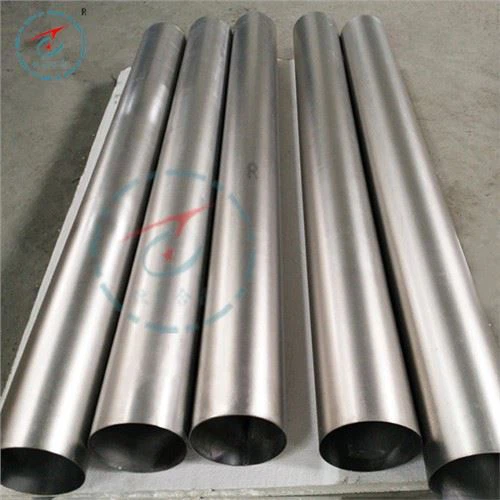
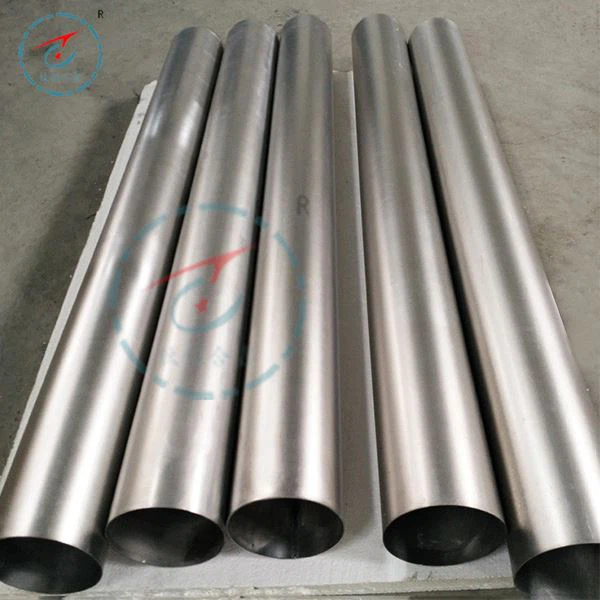
Titanium pipes are lighter in color, usually light gray or silvery white, with a metallic luster on the surface. Titanium pipes are light in weight and high in strength, and their surface texture is relatively smooth and soft. Titanium pipes has good gloss and a certain sense of transparency.

Inert gas shielded welding (TIG welding)
This is one of the most regularly utilized titanium pipe welding methods. TIG welding uses inert gases (such as argon) to protect the welding area from oxygen and nitrogen contamination of the titanium metal. It can provide high quality welds, but at a slower speed.
Electron beam welding
It is the employment of high-speed electron beam to locally heat and melt the titanium pipes to make a weld. It allows for high energy density welding with fast welding speeds and a small heat affected region.
Laser welding
It uses high energy laser beams to melt and weld titanium pipes and tubes. It enables precisely controlled welding processes with the benefits of high speed and high quality.
Cladding welding
In cladding welding, titanium metal powder is sprayed onto the surface of the titanium pipe, melting it, and fusing it with the substrate using a heat source. This technique works well for strengthening or mending particular sections of titanium pipes.
Grade 2
This is the most widely used titanium grade and is known for its excellent corrosion resistance, strength, and weldability. It is commonly used in chemical processing, aerospace, medical, and marine applications. Pipes and pipe fittings used in industrial applications are typically made from Grade 2.
Grade 5 (Ti-6Al-4V)
This grade is the most commonly used titanium alloy and is known for its high strength and corrosion resistance. It is commonly used in aerospace, medical, and industrial applications. Retail good such as bicycle components are often made from Grade 5.
Grade 9 (Ti-3Al-2.5V)
This grade is known for its high strength and excellent corrosion resistance. It is commonly used in aerospace, medical, and industrial applications.
Grade 12 (Ti-0.3Mo-0.8Ni)
This grade is known for its high strength and excellent corrosion resistance. It is commonly used in aerospace and industrial applications.
Grade 23 (Ti-6Al-4V ELI)
This grade is known for its excellent biocompatibility, corrosion resistance, and high strength. It is commonly used in the medical industry for implantable devices such as hip replacements. Almost all medical implants are Grade 23.
Material of Titianium Pipe
Titanium pipe is a pipe made of titanium. Titanium has high strength and its specific strength (ratio of strength to density) is much higher than other metal structural materials, making it suitable for manufacturing lightweight, high-strength parts. Titanium can still maintain a certain strength at high temperatures and is suitable for high temperature environments.
Power generation
Titanium pipes can play a significant role in high-temperature water and steam environments. Grade-2 titanium has already been used in many power plants to handle the problems associated with the failure of condenser and boiler tubes.
Aerospace
Titanium can be used in airframe and engine components for the aerospace industry. Titanium pipes are capable of handling high temperatures without creep. With superior resistance to crack growth and fatigue, the lightweight pipes are recognized for their high strength-to-density ratio.
Oil and gas piping systems
High pressure, high temperature (HPHT) applications such as oil and gas well applications demand piping capable of enduring constant use. The oil and gas industry also needs high corrosion resistance of titanium in areas including downhole, subsea and topside.
Chemical processing
Highly corrosive environments, such as those commonly found in the chemical processing industry, demand piping systems, heat exchangers, and other systems that are capable of handling high loads. With superior corrosion resistance, titanium can endure high stresses for a long period in extreme environments.
Raw material preparation
Select high-purity titanium raw materials, such as titanium ingots or blocks. Pre-treat the titanium materials to eliminate surface oxides, impurities, and contaminants.
Heating of titanium materials
Place the titanium materials in a vacuum furnace or a controlled atmosphere heating furnace. Regulate the heating temperature and duration to attain suitable thermal conditions, typically above the α-β phase transition temperature.
Forging of titanium materials
Forge the heated titanium materials using specialized equipment. Employ forging techniques to shape the titanium materials into cylindrical or tubular forms.
Cold working of titanium pipe
Perform cold working processes like cold rolling or cold drawing on the forged titanium billets. Gradually reduce the diameter and wall thickness of the titanium billets to achieve the desired dimensions of the titanium tubes.
Annealing treatment of titanium pipe
Subject the cold-worked titanium pipes to an annealing process in a designated furnace. Control the annealing temperature and duration to achieve the desired grain size and mechanical properties of the titanium pipes.
Trimming and cutting of titanium pipes
Utilize machining techniques (e.g., milling, cutting) to trim the ends and achieve precise lengths for the titanium pipes. Employ machining processes to ensure smooth and accurate dimensions.
Surface treatment of titanium pipes
Cleaning: Thoroughly clean the titanium pipes to remove surface impurities and contaminants. Acid Etching: Employ suitable acid solutions for acid etching of the titanium pipes, eliminating oxide layers and surface impurities.
Quality inspection of titanium pipes
Conduct visual inspections to detect surface defects, scratches, cracks, etc., in the titanium pipes. Utilize precision measuring tools to measure the diameter, wall thickness, and length of the titanium pipes. Perform hardness testing, tensile testing, impact testing, etc., to evaluate the mechanical and physical properties of the titanium pipes.
Final treatment of titanium pipes
Apply surface coatings such as anodizing or electroplating to the titanium pipes as per requirements. Perform further machining operations, including expanding, bending, etc., based on specific application needs.
Packaging and storage of titanium pipes
Carefully package the titanium pipes to ensure protection during transportation and storage. Store the packaged titanium pipes in a dry, well-ventilated environment with a non-corrosive atmosphere, away from moisture and corrosive substances.
What is the Composition of Titianium Pipe?
High-strength titanium alloyed with 3% Al and 2.5% V. Low-strength titanium plus 0.12-0.25% Pd for enhanced corrosion properties. High-strength titanium alloy plus 0.3% Mo and 0.8% Ni for enhanced corrosion properties. Medium-strength titanium plus 0.04-0.08% Pd for enhanced corrosion properties.
Maintenance Tips for Titianium Pipe
Regularly cleaning
Regularly cleaning titanium pipes are essential to prevent corrosion and blockages. Corrosion can weaken the pipe walls and cause leaks, while blockages can disrupt the flow of materials and cause pressure buildup. Thus, inspecting your pipes for signs of corrosion, rust, cracks, and leaks is crucial.
Regularly inspection
You can use various methods to inspect your pipes, such as visual inspection, ultrasonic testing, magnetic particle inspection, and eddy current inspection. These methods can detect flaws and defects in the pipes and help you determine the extent of damage.
Coating and protection
Coating your titanium pipes can provide additional protection against corrosion and damage. This can also improve the pipe's performance and extend its lifespan. If your pipes are exposed to harsh environments, consider using protective coatings and covers to shield them from damage.
Maintenance and repair
Regularly maintaining and repairing titanium pipes are crucial to prevent failures and accidents. Repairing or replacing the affected pipes immediately is essential if you notice any damage or deterioration during an inspection. Delaying repairs can cause the damage to worsen and increase the risk of failure.
Welding requirements and precautions of Titianium Pipe
● A special welding workshop shall be set as far as possible. Smoking is strictly prohibited in the room. The environment shall be kept clean and dry, and the convection of air shall be strictly controlled.
● Welders shall wear clean work clothes and degreasing gloves during welding. It is strictly prohibited to touch parts with bare hands. The welding area and welding wire surface shall be degreased with acetone.
● High purity argon shall be used for protection, and the purity shall not be less than 99.99%. The air supply flow during welding shall protect the front and back of the weld bead according to the value specified in the process specification.
● During the welding process, the argon flow in the pipe and the argon flow in the welding tool nozzle shall be kept constant to prevent the convex concave phenomenon of weld pool forming in the pipe.
● Short arc welding shall be adopted as far as possible and small welding line energy shall be adopted. When spot welding the nozzle, the gap shall be less than 30% of the wall thickness. Each weld shall be welded at one time as far as possible.
● During welding, the welding tool shall not swing left and right, and the melting end of the welding wire shall not move out of the gas protection zone. During arc striking, air shall be supplied for 10-15s in advance. During arc stopping, the welding gun cannot be lifted immediately. Air supply shall be delayed for 15-30s until the temperature drops below 250 ℃.


Taicheng Group specializes in R & D, production and deep processing of layered metal composites, titanium and titanium alloy series metal materials. The company has two complete metal composite production lines: explosive cladding and explosion with rolling, with an annual production capacity of 50000 tons.


As one of the most professional titianium pipe manufacturers and suppliers in China, we're featured by quality products and competitive price. Please rest assured to buy or wholesale customized titianium pipe made in China here from our factory. Contact us for quotation and pricelist.
Astm B861 Gr2 Titanium Tube for Chemical, Grade 9 Titanium Tube For Industrial Use, Titanium Straight Tubing(0/10)

