

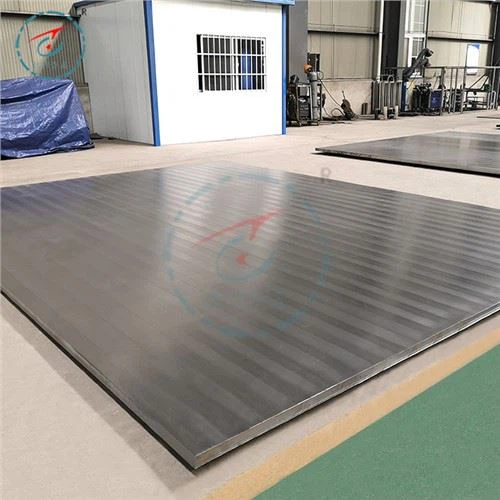
The clad plate, also known as clad steel plate, is a typical laminar metal composite made by bonding the special metal plate to a carbon steel or low alloy steel plate. Generally, the special metal plate is called cladding metal, which comprise less than the greatest percentage of total thickness. The clad plates are designed to improve corrosion/ heat resistance while retaining low cost, high strength, or light weight.
Corrosion resistance
Clad plate is highly resistant to corrosion, making it ideal for use in environments where exposure to corrosive elements is high. This makes it suitable for use in the marine industry, chemical processing, and oil and gas industries.
Lightweight nature
Clad plate is a lightweight material, making it ideal for applications that require materials with a high strength-to-weight ratio. This makes it suitable for use in the aerospace industry, where weight reduction is essential.
High strength
Clad plate has a high strength-to-weight ratio, making it an excellent choice for applications that require high strength and durability. This makes it suitable for use in the defense industry, where protection is vital.
Cost-effective
Clad plates are a cost-effective material in applications requiring high strength and corrosion resistance. This makes it a popular choice for industries that require high-performance materials.




Advanced equipment
We have 50 sets of Grinding & polishing machine, 2 sets of Automatic polishing Machine, 1 set of TianDuan 1600ton oil press machine, 1 set of Thirteen roller straightener etc.
Our honor and patents
We have obtained 1 national invention patents and 17 utility model patents, and was recognized as a high-tech enterprise by Shaanxi Provincial Science and technology department.
Rich experience
Founded in 2005, after more than ten years of hard work and development, it has many subsidiaries.
Rich production experience
The company has two complete metal composite production lines: explosive cladding and explosion with rolling, with an annual production capacity of 50000 tons.
The clad plates are made of rectangular type sheets or plates with thickness of 10 to 320 mm, width of 300 to 5000 mm, and length of 500 to 10000 mm. Other sizes and types of configuration different from a rectangular type are acceptable by a Customer's request. Thickness of cladding metal is from 2 to 12 mm.

Clad plates are engineered by bonding multiple layers of different materials together to create a single, composite structure. This design combines the beneficial properties of each material, such as strength, corrosion resistance, or thermal conductivity, into one versatile product. Other boards, such as solid metal plates or composite boards, are typically made from a single material or a homogeneous mixture of materials. While solid metal plates offer uniformity and simplicity, clad plates provide enhanced performance and versatility for applications requiring specific material properties.
Base metal
The base metal is the foundation of the clad plate and determines its overall strength and stability. Common base metals include carbon steel, stainless steel, and aluminum. Consider the specific requirements of your application, including strength, ductility, and thermal conductivity, when selecting the base metal.
Cladding metal
The cladding metal provides the high-performance surface that enhances the clad plate's properties. Common cladding metals include stainless steel, nickel alloys, titanium, and copper. Consider the specific requirements of your application, including corrosion resistance, wear resistance, and heat resistance, when selecting the cladding metal.
Bonding method
The bonding method used to join the base metal and cladding metal layers is critical to the performance and durability of the clad plate. Common bonding methods include explosive bonding, roll bonding, and diffusion bonding. Consider the specific requirements of your application, including service temperature, stress levels, and corrosive environments, when selecting the bonding method.
Thickness
The thickness of the clad plate is an important factor to consider when selecting clad plate. Thicker clad plates provide increased strength and durability, but also increase the weight of the plate. Consider the specific requirements of your application, including weight restrictions, strength requirements, and fabrication requirements, when selecting the thickness of the clad plate.
Surface finish
The surface finish of the clad plate is important for applications that require specific surface characteristics, such as low friction or improved resistance to abrasion and corrosion. Consider the specific requirements of your application, including surface roughness, surface hardness, and surface integrity, when selecting the surface finish of the clad plate.
Availability
Consider the availability of the clad plate in the required size and thickness. Some clad plates may not be readily available in large sizes or thick thicknesses, which may impact the feasibility of your project.
While the base metal of clad plates may have certain fire-resistant properties, such as high melting points or flame retardancy, the cladding layer can also contribute to fire resistance. For example, cladding materials such as stainless steel or nickel alloys offer excellent resistance to high temperatures and oxidation, making them inherently fire-resistant. The overall fire resistance of a clad plate depends on factors such as the thickness and composition of the composite layers, as well as the specific application and environmental conditions.
Clad plates resist abrasion and wear through the combination of their base material and cladding layer. This dual-layer structure effectively distributes and dissipates impact energy, reducing the wear rate and extending the service life of the clad plate in abrasive environments. The bonding process between the base material and cladding ensures optimal adhesion, preventing delamination and maintaining the integrity of the protective layer over time.

Explosion-bonded clad plates
This type of composite panel involves the use of explosives to create a high-velocity collision between the parent metal and the composite material. The resulting bond is strong and durable, making it suitable for high-stress applications such as oil and gas pipelines, chemical reactors and heat exchangers.
Seam-welded clad plates
This type of cladding involves cold rolling the cladding material onto a base metal sheet, creating a metallurgical bonding interface. This method is suitable for applications requiring corrosion resistance or thermal conductivity, such as the food industry, shipbuilding or power generation.
Metal clad plates
Metal clad plates consist of two or more distinct metal layers bonded together to combine the properties of each material. Common combinations include steel clad with stainless steel or aluminum clad with copper.
Alloy clad plates
Alloy clad plates feature a base metal substrate clad with a layer of specialized alloy material. This configuration enhances the mechanical properties, corrosion resistance, or other specific characteristics of the base metal.
Material of Clad Plate
Clad plate is a composite steel plate produced by bonding any cladding material (like stainless steel) plate to one side or both sides of a carbon steel or low. Hence a clad steel plate not only has adequate strength expected of structural materials (base metal) but also has other features like resistance to heat and corrosion (cladding material) and is more cost-effective then using similar products made entirely of the cladding material.

Oil and gas industry
Clad Plates are used in pipes, containers and tanks that transport or store oil, natural gas or chemicals. The corrosion resistance and high strength properties of Clad Plates make them ideal for these applications.

Aerospace
Clad Plates are used in aircraft structures such as wings, fuselages and engine components. The lightweight and high-temperature properties of Clad Plates are critical for these applications.

Food processing
Clad Plates are used in equipment that handles food and beverages, such as storage tanks, heat exchangers and piping. The hygienic and non-reactive properties of Clad Plates make them safe and reliable for these applications.

Power generation
Clad Plates are used in power plant equipment such as boilers, heat exchangers and turbine blades. The corrosion resistance and thermal conductivity of Clad Plates make them efficient and durable in these applications.
Explosion bonding
In this process, the two metals to be clad together are positioned in close contact with each other. The assembly is then subjected to a high-energy explosion. The explosion creates a high-pressure shockwave that forces the two metals together at an extremely high velocity. The impact of the explosion bonds the metals together, creating a strong metallurgical bond between them. The explosion pressure deforms and cleans the surfaces, removing any oxide layers or contaminants. This results in a strong and durable bond between the base metal and the cladding material.
Roll bonding
In the roll bonding process, the two metals are cleaned and prepared, ensuring the surfaces are free from contaminants. The surfaces are then brought into intimate contact with each other. The bonded surfaces are passed through a rolling mill, and high pressure is applied to establish a solid bond between the metals. The rolling pressure causes the metals to bond together, creating a clad plate with a strong metallurgical bond. The thicknesses of the base metal and cladding material can be adjusted according to the specific requirements.
Components of Clad Plate
Clad plate is a multi-layer metal plate that consists of a base metal layer and one or more cladding metal layers. The cladding metal layer provides a high-performance surface that enhances the corrosion resistance, wear resistance, and other properties of the base metal.
Non-destructive testing techniques such as ultrasonic testing (UT), radiographic testing (RT), and visual inspection are commonly used to detect internal and surface defects, such as delamination, cracks, porosity, or inclusions, without damaging the material. Ultrasonic testing utilizes high-frequency sound waves to detect discontinuities within the material, while radiographic testing employs X-rays or gamma rays to capture images of the internal structure for analysis. Visual inspection involves a thorough visual examination of the clad plate surface for any visible defects or irregularities.
How to Properly Store Clad Plate
Storage environment
The storage environment of clad plates is very important. It is necessary to choose a safe, dry and well-ventilated place to ensure that they are not damp and prevent mold growth.
Temperature and humidity control
The performance of clad plates is easily affected by temperature and humidity, so the temperature and humidity of the storage environment need to be controlled.
Prevent damage
Clad plates need to be protected during storage. When transporting and storing, handle with care and avoid collision and squeezing to prevent damage.
Regular testing
In order to ensure the effectiveness of clad plates, they need to be tested regularly. Testing items include appearance quality, strength, hardness, etc. to determine whether it can continue to be used.
Choose the right tool
In the operation of clad plate, appropriate tools, such as power tools, etc., should be selected to improve efficiency and reduce operating difficulty. At the same time, you need to be careful not to scratch the surface of the clad plate with hard objects to avoid causing damage to the surface.
Cutting safety
During the cutting process of clad plates, you need to pay attention to safety. The cutting tool should use a special plate cutting blade, and the cutting part needs to be firmly fixed to avoid accidents caused by improper operation.
Fixed firmly
When installing clad plates, components such as panels and keels need to be firmly fixed to ensure the stability and safety of the building structure. During the installation process, attention should be paid to the use of special screws and other fixings, and they should be fixed one by one according to reasonable fixing intervals.
Prevent rust
The surface of the clad plates is easily eroded by various natural conditions such as air, rain, snow, etc., and is prone to rust. In order to prevent the board from rusting, it is necessary to apply special anti-rust paint on the surface of the clad plate before operation to extend the service life of the board.


Taicheng Group specializes in R & D, production and deep processing of layered metal composites, titanium and titanium alloy series metal materials. The company has two complete metal composite production lines: explosive cladding and explosion with rolling, with an annual production capacity of 50000 tons.


As one of the most professional clad plate manufacturers and suppliers in China, we're featured by quality products and competitive price. Please rest assured to buy or wholesale customized clad plate made in China here from our factory. Contact us for quotation and pricelist.
separator clad plate, clad steel plate inspection, clad plate catalog(0/10)

