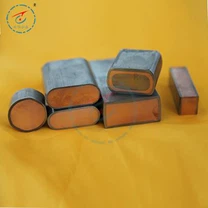



TC4 titanium alloy features high specific strength, outstanding corrosion resistance and good thermal stability. It is widely used in critical components for aerospace equipment, precision machinery and high-end box structures. Nevertheless, titanium alloy has low thermal conductivity, poor cutting plasticity and obvious work hardening, making it a typical difficult-to-machine material. In particular, the 2mm ultra-thin wall cavity structure suffers from low rigidity and strict wall thickness uniformity requirements. During machining, cutting chatter, stress deformation, dimension out-of-tolerance and flatness deviation are highly likely to occur, which seriously restrict the dimensional accuracy and assembly sealing performance of finished parts.
Taking the TC4 titanium alloy 2mm thin-wall arc cavity cover plate as the research object, this paper systematically analyzes the machining difficulties of thin-wall cavities considering the structural characteristics of parts and actual machining conditions. Machining flow, tool selection, clamping method and finishing process are optimized to form a stable, efficient and high-precision machining solution for thin-wall titanium parts.
1. Part Structure and Technical Requirements
The machined component is a large curved-surface thin-wall cavity cover plate. The uniform wall thickness of the main cavity is only 2mm, and the connecting shoulders at both ends are thickened to 6mm. It adopts a closed cavity structure with arc curved surface. Serving as a sealing cover for the box body, the part has strict assembly precision requirements: the flatness of the mounting joint surface ≤0.1mm. The cavity curved surface shall be smooth and continuous without chatter marks, pits, edge collapse or deformation defects, so as to meet the sealing performance and long-term service stability of the complete equipment.
With thin wall, large curved surface, low rigidity and high precision, the part represents a typical difficult component in precision machining of titanium alloy.
2. Analysis of Machining Difficulties
2.1 Cutting Chatter
TC4 titanium alloy generates high cutting temperature with poor thermal conductivity. Cutting heat concentrates on the contact area between cutting edge and workpiece, which easily triggers high-frequency cutting vibration. The thin-wall area has extremely low rigidity, which amplifies vibration. Ripples, tool marks and chatter marks tend to appear on the machined surface, directly impairing surface finish and dimensional accuracy of the curved surface.
2.2 Thin-wall Deformation
The 2mm ultra-thin wall has weak deformation resistance. Uneven cutting allowance in roughing, concentrated residual stress and unbalanced clamping force will lead to cavity collapse, wall thickness offset and curved surface warping. Conventional machining processes often encounter a common problem: qualified dimensions after machining, but rebound deformation and out-of-tolerance after workpiece unclamping.
2.3 Challenge in Flatness Control
The sealing mounting surface requires high-precision fitting. Residual stress accumulated in multiple milling operations may cause surface arching, depression and inclination, making it hard to stably meet the flatness tolerance of 0.1mm.
3. Optimization of Overall Machining Route
Based on the structural features of the part, the overall machining principle is adopted: machine outer profile before cavity, rough machining before finishing, interspersed stress relief and multiple micro-finishing passes.
Full process flow: Blank pretreatment → Rough & finish machining of outer profile → Machining of mounting holes → Rough and finish milling of convex cavity → Stress relief treatment → Slotting rough & finish milling of concave cavity → Finish milling of mounting surface → Precision grinding & lapping shaping → Precision inspection
4. Key Processes and Tooling Solutions
4.1 Machining of Convex Cavity
For roughing, high-cobalt 4-flute carbide end mills are selected. The tools feature high rigidity and excellent anti-chatter performance, suitable for large material removal of titanium alloy. Sufficient high-pressure cutting fluid is continuously supplied throughout the process to reduce cutting temperature, mitigate tool wear and restrain work hardening.
For finishing, polycrystalline cubic boron nitride (PCBN) ball end mills are used, together with streamline curved surface following finishing strategy. Uniform tool path and stable cutting load effectively suppress thin-wall vibration. The machining error of curved surface is controlled within 0.012mm to ensure continuous and smooth arc cavity.
4.2 Concave Cavity Machining and Anti-deformation Control
Integrated positioning and clamping with custom tooling is applied for concave cavity, realizing zero displacement and high-rigidity support of the workpiece, and reducing chatter and micro-deformation from the source.
Layered slotting is adopted in roughing to remove allowance uniformly and avoid local stress concentration. Natural aging process is added after roughing to fully release cutting residual stress and prevent rebound deformation in subsequent finishing.
Multiple repositioning by flipping workpiece is used for finishing. The reference datum is corrected repeatedly to eliminate accumulated clamping error, ensuring uniform 2mm wall thickness and symmetrical & stable cavity structure.
4.3 Precision Forming of Sealing Mounting Surface
The precision of mounting surface directly determines the sealing performance of the whole equipment. Stable positioning datum is selected and clamping force points are unified during machining. Rough milling is firstly performed to remove allowance and tool marks, followed by compound process of precision grinding plus lapping for gradual micro-shaping.
On-line inspection is arranged throughout machining to correct flatness deviation in real time and converge flatness error, steadily achieving the technical index of 0.1mm flatness.
Conclusion
Aiming at the industry pain points of obvious chatter, large deformation and difficult precision control in machining TC4 titanium alloy 2mm ultra-thin wall cavity cover plate, this optimization selects proper tool system, adjusts cutting strategy, adds stress relief procedures, customizes tooling positioning scheme and adopts composite precision shaping technology. It successfully solves common defects in thin-wall titanium machining including chatter marks, collapse, rebound and flatness out-of-tolerance.
Practical machining proves that reasonable process arrangement, rigid clamping, layered material removal, stress relief and micro-finishing are the core to realize high-precision forming of thin-wall titanium alloy. This process solution boasts high stability and high yield rate, and can provide reliable technical reference for precision machining of similar aerospace thin-wall cavity and sealing structural titanium alloy parts.
(The above content is compiled from online resources for reference only.)