


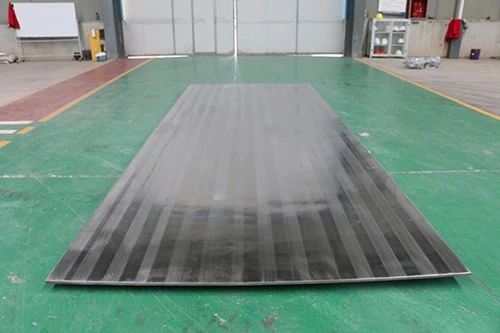
1 Products Description
Due to the activity of titanium and its sensitivity to heating, titanium welding is the key process for the manufacture of Titanium Clad Steel Plate for vessels. Before welding, the inert gas protection towing cover shall be prepared in advance according to the weld form, so that the weld and the base metal heat affected zone with the temperature above 400 ℃ are under the inert gas protection. The base metal and welding wire shall be cleaned, and if necessary, wiped with ethanol or propanol before welding to completely degrease. The shielding gas shall be argon with purity above 9999%. Welders must wear clean work clothes, work shoes and white gloves before entering the titanium clad welding area for construction. Generally, preheating is not required for titanium welding, but the temperature of weld bead and base metal should always be kept between 5~150 ℃. The welding of titanium clad layer shall adopt the welding process with low linear energy, but without melting to the steel surface, and can obtain the maximum penetration. During titanium welding, the arc striking plate and arc extinguishing plate shall be used as far as possible. Arc striking on the surface of the workpiece outside the groove is not allowed. If the tungsten electrode touches the weld metal during the welding process, the welding shall be stopped immediately. This part of the weld shall be removed, and the tungsten electrode shall be replaced or corrected again. It is strictly forbidden to grind the titanium strip and weld with the grinding wheel that has polished the steel base.
2 Non-destructive testing and repair of welds
Non-destructive testing of welds
a.The welds of shell, head and main pressure parts shall be subject to nondestructive testing after passing the appearance inspection.
b. Unless otherwise specified in the design drawing, the inspection shall be carried out according to the following provisions.
1) The butt welds of pressure vessels and heat exchangers shall be subject to 100% radiographic and ultrasonic flaw detection;
2) Class C and D welds of pressure vessels and heat exchangers as well as cladding welds of clad steel plates shall undergo 100% penetrant testing.
c. Evaluation criteria.
1) Radiographic inspection of welds shall be carried out according to Chapter 2 of JB4730-94 Nondestructive Testing of Pressure Vessels, Class AB and Class II are qualified;
2) Ultrasonic flaw detection of welds shall be carried out according to Chapter 3 of JB4730-94 Nondestructive Testing of Pressure Vessels, and Class I is qualified
3) Penetrant testing of welds shall be carried out in accordance with Chapter 4 of JB4730-94 Nondestructive Testing of Pressure Vessels, and it is qualified in Class I

d. Repeat the inspection.
1) If there are any unacceptable defects in the weld after radiographic inspection, repair welding shall be carried out after the defects are removed, and the part shall be re-inspected. The number of repair welding should not exceed 2.
2) Porosity and slag inclusion with diameter less than 0.5mm and undercut with depth less than 0.5mm found in penetrant flaw detection are allowed to be polished smoothly. For cracks and defects exceeding the above size, repair welding is required after the defects are completely removed.
3Pickling and packaging
A. Titanium Clad Steel Plate for vessels are polluted by iron, oxygen, hydrogen and other impurities in different degrees during the manufacturing process, which endangers the use of titanium equipment, so the pollution layer must be removed. Acid cleaning is one of the effective methods to remove the oxide contamination layer on titanium surface. When blue oxide is generated on the surface of titanium container due to thermal processing (including welding), it can be removed by acid pickling until the surface presents silvery white metallic luster. The formula of pickling solution is: nitric acid (HNO3) 50%+water (HO) 50%. During operation, use white cotton cloth to dip in the pickling solution while wiping and washing with water (the pickling solution cannot stay on the product surface or part for more than 10s) until the surface presents silvery white metallic luster.
B. The painting, packaging and transportation of equipment shall be carried out in accordance with the relevant provisions of JB2536-80 Pressure Vessel Painting, Packaging and Transportation, but the titanium surface shall not be painted.
Hot Tags: titanium clad steel plate for vessels, China, manufacturers, suppliers, factory, customized, wholesale, buy, price, quality, quotation, pricelist, in stock, for sale, made in China, aluminium rainscreen cladding panels, ASTM B265 GR2 Titanium Clad Stainless Steel Plate, titanium alloy clad plate, Titanium Clad Stainless Steel Plate for reaction kettle, Titanium Clad 304L Stainless Steel Plate, High Strength Titanium Clad Steel Plate


