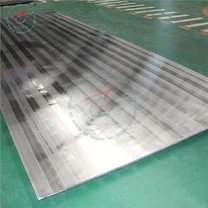
Titanium plate is one of the most widely used products in the titanium material industry.Its excellent quality originates from the precise smelting of raw sponge titanium and refined full-process processing.The production of titanium plates adopts TA1/TA2 high-purity sponge titanium,with strict control over harmful impurities such as oxygen(≤150ppm),nitrogen and iron(≤0.08%),ensuring the raw material purity reaches no less than 99.6%.It fundamentally endows titanium plates with outstanding corrosion resistance,ductility and weldability,laying a solid foundation for subsequent application.

Titanium features active chemical properties and is prone to gas absorption and oxidation.For this reason,sponge titanium must be smelted under a high-vacuum environment to guarantee the high purity of finished titanium plates.At present,two mainstream processes are widely applied in the industry. Vacuum Arc Remelting (VAR), the dominant industrial process, compresses sponge titanium into electrode blocks and welds them into consumable electrodes. The electrodes are melted into titanium liquid by electric arc in a water-cooled copper crucible, and remelted 2 to 3 times to remove internal inclusions, homogenize chemical composition and reduce segregation. Electron Beam Cold Hearth Melting (EB) is applied for the production of high-end and high-purity titanium plates. It directly bombards sponge titanium with electron beams to complete melting and refining in a water-cooled cold hearth. High purity standards can be achieved in a single melting process, which effectively reduces impurity content and avoids crucible contamination.
After smelting, titanium ingots with uniform composition, compact structure and crack-free performance are obtained. The ingots are heated at 950-1150°C, then subjected to multiple upsetting and stretching processes by hydraulic presses for forging and cogging. This refines grain structures, eliminates internal porosity, and preliminarily forms titanium slab blanks that meet the requirements of subsequent processing.
Further precision procedures are required for titanium slab blank processing. Firstly, multi-pass hot rolling is carried out at 850-1050°C to reduce the slab thickness from 100-200mm to 4-20mm and optimize structural properties. Pickling is then performed to remove surface oxide scale and contaminants so as to ensure processing accuracy. Cold rolling at room temperature can be adopted according to product requirements to achieve precise dimensions below 0.5mm and high surface finish. Multiple annealing treatments are arranged during the process to prevent cracking caused by work hardening. Finally, finished product annealing is conducted at 550-750°C to eliminate internal stress, restore ductility and stabilize the microstructure. The entire production process strictly complies with domestic and international standards including GB/T and ASTM B265, ensuring full batch traceability and stable product quality.
Manufactured through the above complete process, titanium plates are widely used in chemical industry, new energy, aerospace, medical treatment and other fields by virtue of high purity and uniform microstructure. Every procedure from high-purity sponge titanium to qualified finished titanium plates imposes strict requirements on process precision. Such refined process control endows titanium plates with excellent comprehensive performance, enabling them to play an indispensable role in all walks of life.