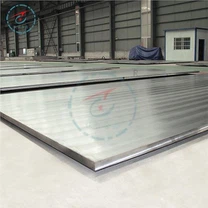
Titanium steel composite plate not only has the corrosion resistance of titanium, but also has the excellent weldability, formability and thermal conductivity of carbon steel, and also saves precious titanium metal. Titanium steel clad plates are widely used in marine industry, petroleum industry, electric power and nuclear energy and other fields due to their excellent performance. At present, the main production methods of titanium clad steel plates are explosive cladding method, explosion-rolling cladding method and direct rolling cladding method. Compared with the explosive cladding method and the explosion-rolling cladding method, the direct rolling cladding method can produce clad plates with wide plate width, thin coating and uniform interface properties. Among the various methods mentioned above, due to the limitation of the interfacial bonding strength, only explosive cladding can be used to prepare titanium-steel composite materials in production. The main factor restricting the bonding strength of rolled clad plate is the formation of intermetallic compounds at the interface, and the surface treatment method, rolling temperature, interface structure and interfacial carbides will all affect the growth of intermetallic compounds.
In order to solve the problem of the shear strength of the titanium-steel composite plate, the predecessors used the method of adding a metal intermediate layer to adjust the diffusion of composite interface elements and improve the effective means of interface bonding strength, such as Ni, V, Nb, Mo, Cu, IF steel and pure iron. The addition of the metal interlayer does solve the problem of the formation of Fe-Ti compounds, but it will also bring some other problems, so the shear strength of the titanium-steel clad plate cannot be improved, or even decreased. Metal interlayers such as Nb and Mo that can be infinitely miscible with Ti can be well connected to the titanium side of the titanium-steel clad plate, but hot rolling at 950 ° C will produce a large number of micropores at the junction with the steel side, The shear strength of the composite plate is reduced; the metal interlayer with limited solid solution with Ti, such as Ni and Cu, will form a new intermetallic compound with titanium, so it cannot effectively improve the shear strength of the titanium-steel composite plate. , Rolling and compounding at more than 900 °C will even decrease.
At present, it is difficult to select an intermediate layer that can combine well with Fe and Ti interface structures at the same time. Using the interface product TiC generated in the preparation process of GR3 carbon steel may become an important method to solve the interface bonding strength of titanium-steel composite materials. Compared with Fe-Ti intermetallic compounds, TiC has better mechanical properties, and the standard molar Gibbs free energy of formation of TiC is lower. At present, only relying on the rolling process cannot guarantee the stable existence of TiC at the bonding interface. When the rolling temperature is above 850°C, TiC will decompose under the action of thermal stress and cannot exist stably. In order for TiC to exist stably at the interface, the rolling temperature must be lowered to below 850°C, which will cause two problems in practical applications: one is that some carbides in the base material cannot be dissolved, which affects the mechanical properties of the prepared material ; The second is rolling at a temperature below 850°C. At present, most rolling mills are facing the problem of insufficient rolling capacity. In this context, it is necessary to find a composite interface control method that can moderately increase the composite rolling temperature and ensure the bonding strength of the interface.
(1) After modifying GR3 with Ga element, the interface structure on the titanium side is α-Ti, which realizes the control of the interface structure on the titanium side, and the diffusion of Fe and C to the titanium side is significantly reduced.
(2) After adjusting the structure of the titanium side interface, a single TiC layer is formed at the bonding interface. At 850-900°C, the thickness of the TiC layer does not change significantly, which are 190 and 180nm respectively, but part of the dispersed TiC disappears and becomes a continuous and uniformly distributed TiC layer; when the temperature rises to 950°C, the thickness of TiC The sharp increase is 510nm.
(3) The shear strength of the titanium-steel clad plate is 225, 235, and 140MPa at the rolling temperatures of 850, 900, and 950°C after the microstructure of the titanium-side interface is regulated. When the rolling temperature is 900°C, the shear strength of the titanium-steel clad plate can be ensured while increasing the rolling temperature of the titanium-steel clad plate and reducing the burden on the rolling equipment.
Baoji Taicheng Clad Metal Materials Co., Ltd is a professional titanium steel clad plates supplier. Our company is equipped with complete and professional staff in every link from research and development to production and processing to sales. Whether you are interested in our products or want to For more product-related knowledge, you are welcome to contact us!