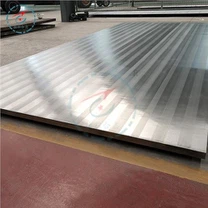
In the first half of 2026,China's titanium-steel clad plate industry continued to iterate and upgrade on the basis of traditional production processes.A number of new process production lines and environmental protection technological transformation projects with mass production capacity have been put into operation.The two mainstream processes,rolling cladding and explosive cladding,have achieved stable mass production and supply.Meanwhile,the supporting national standard testing rules have been fully implemented,further raising the overall quality control threshold of the industry.
A number of practical projects in the rolling cladding sector have been successfully commissioned. In June,the first cold rolling production line of Hunan Hongwang's 100,000-ton titanium material and composite material project was officially completed and put into operation.Focusing on ultra-thin and standardized thin plates,the single production line boasts an annual capacity of over 20,000 tons,continuously supplying bulk products for chemical heat exchangers,pressure vessels and other fields.Meanwhile,the second-phase vacuum rolling production line of Baowu Yancheng base in Jiangsu has reached full production.Adopting the whole-process vacuum hot rolling process,it can stably produce titanium-steel clad plates with a thickness ranging from 8mm to 120mm.The interfacial shear strength of the products fully meets the ASME material standards for pressure equipment,and stable supply has been realized for many large chemical equipment enterprises.In May,Jiuhong Hongyu New Materials achieved the stable industrial rolling of 2.5mm ultra-thin titanium-steel clad plates,filling the domestic gap in the continuous rolling capacity of thin-gauge clad plates and effectively solving common industry problems such as plate delamination and uneven plate shape in conventional rolling processes.
The explosive cladding process has completed green and environmentally friendly upgrading.Chongqing Institute of China Coal Technology & Engineering Group has realized the stable industrial production of underwater explosive clad plates,capable of manufacturing large-area dissimilar metal clad plates of more than 6 square meters in a single operation.By using water to buffer detonation shock waves,this process thoroughly eliminates the dust and noise pollution problems of traditional open-air explosive operations.The produced titanium-steel clad plates are widely applied in corrosion-resistant industrial furnace liners,large pressure vessel tube sheets and other scenarios,reducing the comprehensive procurement cost for downstream enterprises by nearly 50%.Leading enterprises including Weihai Huaji and CSSC 725 Research Institute have completed the upgrading of detonation equipment.The interfacial bonding qualification rate of titanium-steel clad plates has remained steadily above 99.5%,and the delivery cycle for customized extra-thin and special-shaped clad plates has been shortened by 30%,greatly improving production and delivery efficiency.
In terms of quality control,the detailed implementation rules ofTitanium-Steel Clad Plates (GB/T 8547-2019) have been strictly enforced this year.The specification clearly requires that all industrial clad plates must undergo 100% ultrasonic flaw detection,and be marked with permanent steel stamps and stenciled identification.Products with vague or untraceable marks are prohibited from delivery.With the continuous release of high-quality industrial capacity,the two cladding processes have formed a distinct differentiated and complementary pattern.Rolling cladding is suitable for mass production of standardized thin plates,while explosive cladding specializes in the customization of extra-thick and special-shaped special components.The independent supporting and high-end manufacturing supply capacity of domestic titanium-steel composite materials has achieved substantial improvement.