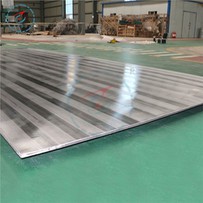
1 Products Description
In 1939, Bowden and Tabo of Cambridge first proposed that surface mechanical occlusion is the main part of metal solid phase composite.
Because their experiments show that the size of Stainless steel aluminum bimetallic clad plate by explosive weld surface roughness has a certain influence on the bonding of two metals. The mechanism of initial bonding of metal interface during solid phase bonding is mainly the crack mechanism. The initial bonding at the interface of the clad plate rolled at different temperatures is mainly a crack mechanism, and there are many wide cracks at the steel side when the total reduction is 31%.
On the Stainless steel aluminum bimetallic clad plate by explosive weld composite plate interface, when the total reduction is 49%, although there are some cracks, they are not very wide, and they have formed a good bond. This shows that the crack is not the main reason for the composite plate to form the initial bonding, but only the precondition for forming a bonding. This is because when the stainless steel surface cracks, the inner metal produces plastic deformation and is squeezed into the stainless steel crack under pressure. After the joint surface is torn, some inner metal elements remain near the crack.
2 Products Features
Bonding mechanism of bimetal composite
Metal bond theory
In 1954, Burton MS put forward the theory of metal bond bonding through the study of metal recombination.
When two clean metal atomic planes move from infinite distance to atomic level distance under the action of external force (pressure), due to the influence of the interatomic force, the bond will be formed due to the exchange of force. Take the internal energy of diatoms as an example. When two atoms move closer, the repulsion force is small enough to be ignored, while gravity is getting bigger and bigger. If the distance is 10 〜 10mm, the atom moves closer under the action of gravity, and the atom does work to the outside world, so the potential energy drops to a negative value. Further closer, the repulsive force will be strengthened. At a distance where the repulsion force is greater than the atomic gravity, atoms close to each other will increase the potential energy. Therefore, at a certain distance, the potential energy has a minimum value. This distance is called the equilibrium distance, and the corresponding U value is equal to the work that must be done to pull the atoms apart until they have no influence on each other. During rolling cladding, the surface of the component is polluted by gas, water vapor or other pollutants, which hinders the interaction of metal electrons. Only when the surface layer is broken due to extension deformation, the active metal in the inner layer is extruded to the surface to contact each other, forming metal bonding. Therefore, the energy required for recombination is mainly to promote surface deformation, rather than increase surface energy. He believes that all composite technologies are completed by this kind of composite action, which is the chemical contact to achieve the bonding between metals. This theory is generally accepted, but it is not suitable for explaining some problems in the field of low-temperature recombination.


3Application of Clad Plate
Nowadays, a large number of researchers combine the respective advantages of alloy and steel to realize the connection of steel structures, which has produced huge social and economic benefits. Among them, the more common connection of Shaoxing steel structure is the connection of alloy steel without inducing steel. At present, the automobile manufacturing industry is becoming more and more developed, but the development of new energy has not made further progress, In the industrial production of modern automobiles, one of the important technologies for energy conservation and emission reduction is to realize the composite connection of steel pot alloy. In order to achieve the lightweight index of automobiles, the use of steel pot connection has become a very important way.
4 FAQ
What is Explosive welding?
In the process of explosive welding, due to the high-speed movement of the clad plate, a thin layer of metal at the contact surface between the base plate and the clad plate forms an interface waveform under the action of shear stress, at the same time, the grains can undergo fibrous deformation. At the same time, due to the plastic deformation at this time, most of the kinetic energy brought by the explosive will be changed into internal energy, which can reach more than 90% of the explosive energy, At the same time, it can also recrystallize the grains at the interface and nearby, and generate various structures such as equiaxed crystal, microcrystalline martensite, nanocrystalline, amorphous or adiabatic shear band [22_25]; At the same time, due to the effect of high temperature and high pressure, the substrate clad metal will also have mutual diffusion. It can be seen that explosive welding has the characteristics of fusion welding, pressure welding, and diffusion welding.
Hot Tags: stainless steel aluminum bimetallic clad plate by explosive weld, China, manufacturers, suppliers, factory, customized, wholesale, buy, price, quality, quotation, pricelist, in stock, for sale, made in China, UNS S32205 Stainless Steel Clad Steel Plate for Heat exchanger, kitchen grade stainless steel sheets, SS304L Stainless Steel Clad Steel Plate tube sheet, 316L Stainless Steel Clad Copper plate, SS304 Stainless Steel Clad Steel Plate tube sheet, Cladded Copper-Stainless Steel Plate