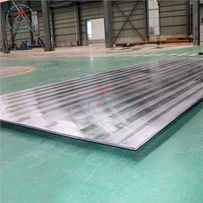
1 Products Description
With the development of domestic pressure vessel manufacturing technology, GR1 titanium clad steel plate for pressure are increasingly used in the manufacture of corrosion-resistant pressure vessels due to their excellent performance and economy. However, due to the particularity of its materials, most domestic manufacturing enterprises lack manufacturing experience, so the manufacturing supervision and inspection of its manufacturing process should be paid special attention. The author believes that the manufacturing supervision and inspection should focus on strengthening the control of materials, welding process control and other links to ensure the safe operation of titanium clad plate pressure vessels in the future use process.
2 Design of container
Because titanium itself has different characteristics from ordinary carbon steel and stainless steel, for example, the melting point of titanium is 1668 ℃, which is higher than other metals (such as steel, stainless steel, aluminum, copper, etc.): industrial pure titanium and most titanium alloys can be welded themselves or each other, but can not be fused with other metals, for example, the solubility of iron in titanium is only 0.05%~0.1%, and iron that exceeds the solubility forms brittle titanized iron phase in titanium, resulting in serious embrittlement of titanium, Therefore, titanium cannot be fused with steel, and even fine iron is not allowed to enter into titanium welding. The tensile strength and other mechanical properties of industrial pure titanium change with temperature more than that of ordinary carbon steel and low alloy steel; After the temperature rises, the tensile strength and yield strength of the container decrease sharply. At about 250~300 ℃, the tensile strength and yield strength are about half of those at normal temperature, etc., so the strength and structural design of the container is much more difficult and complex than the conventional design.
3Structural design
Selection of head form For heads of high-pressure vessels, spherical heads are usually used.
Because the spherical shell has the same radius of curvature everywhere, its membrane the stress is uniformly distributed along the whole spherical shell and the size is equal, and the stress condition is the best. However, Qincai has a high yield strength, a large deformation pressure and a large yield ratio, a narrow range of allowable plastic deformation, a large ratio of crack yield strength to elastic modulus during cold working, a large rebound amount during cold working, a low relative elongation and relative area shrinkage, and a large tendency to cold work hardening, which is unfavorable to pressure working deformation. In addition, for GR1 Titanium Clad Steel Plate for Pressure.
As the thermal expansion coefficient and elastic modulus of titanium and steel are different, the thermal deformation difference between them will increase with the increase of temperature, which will cause greater thermal stress at the interface and lead to the peeling of titanium composite layer.


4 Problems needing attention in the manufacturing process of titanium clad plate equipment
Features of titanium-clad plate welding equipment
The cladding of stainless steel clad plate is integrated with the base layer, so the welded joint of stainless steel clad plate can bear the load together with the base layer. However, the clad layer of titanium composite plate cannot be fully integrated with the base layer, so the titanium clad layer is only supported by the welded joint of its own thin layer. In addition, the average linear expansion coefficient of titanium is about 8.5 × 10⁻⁶/℃.
5 Pay attention to the preparation before welding
Water, oil, oxide and other pollutants in welding will seriously damage the quality of titanium welding joints. Therefore, the welding wire, groove and its surrounding areas should be cleaned. This cleaning requirement is much stricter than the requirements for the cleanliness of steel and aluminum welding. The surface polished by grinding wheel and the parts with oxide film on the surface must be scraped with a scraper to ensure the quality of the welded joint. The cold work forming site must be isolated from other material and equipment manufacturing sites, and there are facilities to prevent iron or other metal dust pollution sources.
6 Strictly control the harmful impurities in the welded metal and welding materials
Oxygen, hydrogen, nitrogen, carbon and iron are interstitial elements of titanium, which can be dissolved in titanium to form interstitial solid solution. When the content of the above elements exceeds its solubility in titanium, they will form various compounds with titanium, making titanium brittle, increasing strength and hardness, and decreasing plasticity. This process is irreversible. Titanium weld belongs to casting structure, which inevitably has defects such as porosity, segregation, porosity, coarse grain (even within the allowable defect range of flaw detection), and is used after welding. Even if the welding process is well protected, impurities will always increase but not decrease. If the titanium welding wire with the same impurity content as the base metal is used for welding, the plasticity of the titanium weld is much lower than that of the base metal, which is very easy to cause the titanium weld cracking in the use of titanium containers and even in the manufacturing process. The only feasible way to improve the weld plasticity is to reduce the impurity content in the welding wire. Therefore, the selection of titanium welding wire is very important. The welding wire in Appendix D of JB/T4745-2002 Titanium Welding Vessel can be selected, and the qualified imported welding wire with much lower impurity content than the base metal can also be selected.
Hot Tags: gr1 titanium clad steel plate for pressure, China, manufacturers, suppliers, factory, customized, wholesale, buy, price, quality, quotation, pricelist, in stock, for sale, made in China, Titanium Coating Stainless Steel plate, Titanium Clad Steel Plate, Titanium Aluminum armor plate for Industry, Titanium Clad Stainless Steel Sheet for Heat Exchanger, b i metal sheet, Stainless Steel Titanium Hot Rolled Clad Sheets