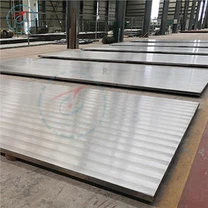
Titanium steel composite plates can fully combine the excellent corrosion resistance and thermal stability of titanium metal, as well as the high strength of structural steel, thus combining the advantages of cladding and substrate metal, and have good engineering application prospects . Titanium steel composite plates are generally processed by explosive or rolling composite methods. The mechanical properties of the composite plate are affected by various factors such as the mechanical properties of the cladding and substrate, the bonding interface properties, and the composite ratio, which often require specialized research.
Currently, scholars have conducted relevant research on the mechanical properties of titanium steel composite plates from different perspectives. Xie et al. studied the microstructure and mechanical properties of explosive hot-rolled composite plates of industrial pure Ti-X65 pipeline steel using metallographic observation and mechanical testing methods. The results showed that the interface morphology directly affects the bonding quality between the titanium coating and the steel plate. Liu et al. studied the mechanical properties of titanium steel composite plates through experiments and observed the interface morphology of the plates. The results showed that the shear strength of wavy interfaces was higher than that of straight interfaces. Ban Huiyong et al. [4] conducted monotonic tensile, bending, and shear tests on TA2/Q235B titanium steel composite plates, and the results showed that the composite ratio of titanium steel composite plates directly affects their stress-strain curve and mechanical performance indicators. In addition to static performance, the mechanical performance of titanium steel composite plates under cyclic loading is also crucial. However, according to publicly available literature, there are currently no experimental results on the hysteresis performance of titanium steel composite plates under cyclic loading both domestically and internationally.
To investigate the hysteresis constitutive relationship of titanium steel composite plates under cyclic loading, monotonic tensile tests and loading tests under six different cyclic loading regimes were conducted to obtain their static and hysteresis properties. The Ramberg Osgood expression is used to fit the experimental skeleton curve, and the plastic constitutive model is used to describe its hysteresis performance. The material parameters in the model are calibrated based on the experimental results. Finally, the finite element software ABAQUS was used to numerically simulate the cyclic load test process.
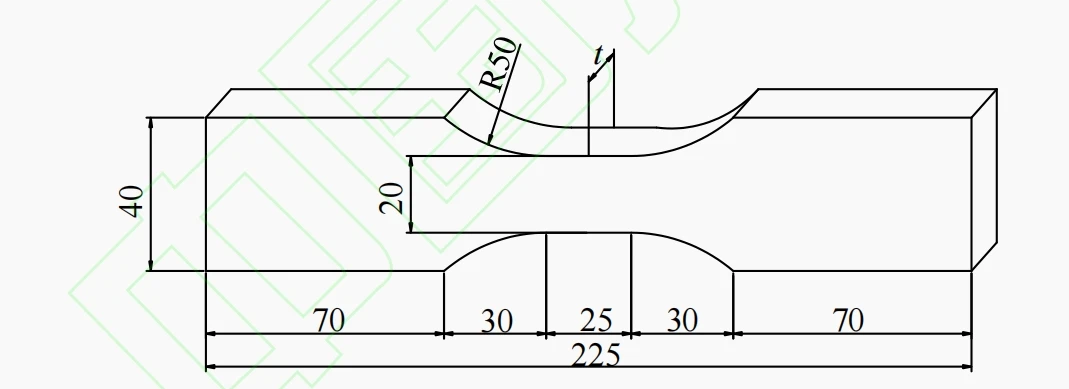
The titanium steel composite plate used in the experiment is composed of TA2 titanium metal and Q235 steel that have been explosively compounded. The nominal thickness of titanium steel composite plates includes four types: 11.2mm, 13.2mm, 15.2mm, and 17.2mm. The nominal thickness of the titanium layer is 1.2mm, forming four different composite ratios. The dimensions of the specimens were designed according to references [4] and [6], as shown in Figure 1. The clamping section and parallel section of each specimen were transitioned by a circular arc with a radius of 50mm. A total of 28 specimens were designed, including 4 monotonic loading specimens and 24 cyclic loading specimens, all of which were processed using wire cutting along the rolling direction of titanium steel composite plates.
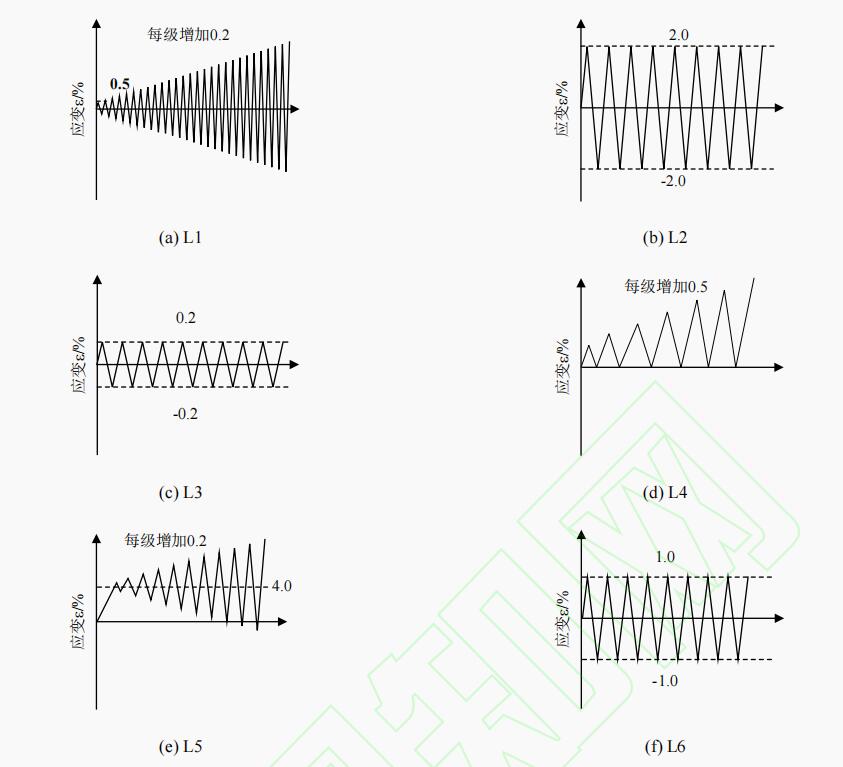
In order to prevent the specimen from buckling under compression too early during the loading process and obtain a relatively full hysteresis curve, the loading system is determined based on the principle of less compression and gradual progress. Six different cyclic loading regimes were designed (Figure 2), all of which were loaded according to displacement control. Among them, loading regimes L1, L4, and L5 were equal incremental loading, while L2, L3, and L6 were equal amplitude loading. Loading regimes L4 and L5 can delay or even avoid buckling caused by compression of the specimen, resulting in a fuller hysteresis curve.