
Distillation tower is an important equipment commonly used in petrochemical production, which enables close contact between gas-liquid or liquid-liquid phases, achieving the purpose of mass and heat transfer between phases. With the development of China's petrochemical and refining industries, the use of highly corrosive media is increasing, and the requirements for materials are becoming higher. Corrosion resistant materials such as non-ferrous metals and their composite plate equipment are becoming more and more widely used. This article takes a distillation tower in a PTA project as an example to explain the problems encountered in the design process of the distillation tower, hoping to provide some reference for similar equipment in the future.

1. Main parameters
And the selection of distillation tower working medium is: acetic acid, water, etc; The design pressure is 1.4MPa/FV; Design temperature 245 ℃ @ 1.4MPa/100 ℃ C @ FV. The basic wind pressure is 500N/㎡; The seismic intensity is 7 degrees; The basic seismic acceleration is 0.10g; set up
The seismic grouping is the first group; The soil type of the site is Class IV, and the ground roughness category is A. The schematic diagram of equipment structure dimensions is shown in Figure 1. The medium in PTA plant has strong corrosiveness, and titanium material can better meet the corrosion resistance requirements. Due to the high price of titanium material and its unsuitability for manufacturing large pressure vessels, using titanium steel composite plates to manufacture pressure vessels can significantly reduce equipment costs. TA1 has lower strength, better toughness, and less residual stress after explosion. The bonding strength of the composite plate is higher. Therefore, when selecting TA1+Q345R as the main compression component material and titanium steel composite plate, the cladding is not included in the strength and only considered
Considering the strength of the base layer, it is necessary to propose requirements for carbon equivalent, hardness, impact testing, ultrasonic testing, etc. for Q345R used in the base layer to ensure the mechanical properties of the base steel plate. To ensure a tight bond between the coated titanium material and the base steel plate, the titanium steel composite plate should be explosively bonded, in accordance with the provisions of NB/T47002.3-2019 B1 level, and supplied in a stress relieving annealing state. The shear strength of the composite plate should be ≥ 180MPa when supplied.
Due to manufacturing processes such as cylinder rolling, head forming, and post weld heat treatment during equipment manufacturing, the shear strength of composite plates may decrease. To ensure equipment safety, after the completion of equipment manufacturing, the shear strength of composite plates should also be ensured to be no less than 140MPa.
2. Main structural design of the equipment
2.1 T-shaped welded joint structure of titanium steel composite plate
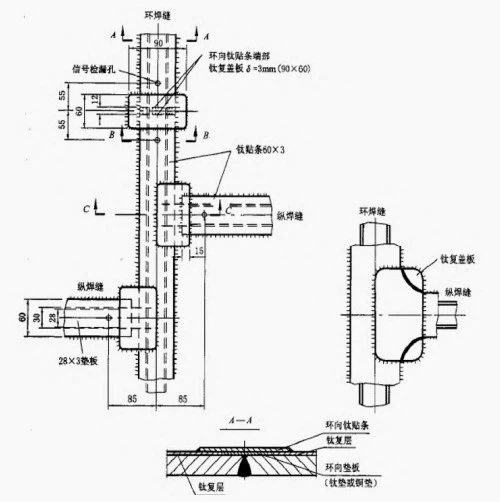
The T-shaped joint structure at the longitudinal and circumferential welding joints of the composite plate is shown in Figure 2. A separate T-shaped cover plate with a rounded corner is usually used at the T-shaped joint. For the convenience of argon gas protection on the back during welding and leak detection of the overlap joint of the cover plate, at least 2 Φ 6 leak detection holes should be drilled on the gasket of each longitudinal and circumferential welding joint, and the location of the leak detection holes should be as close as possible to the high and low points of the longitudinal weld and the two ends of the circumferential welding joint. In order to detect leakage points in a timely manner and reduce the consumption of argon gas to protect the back during welding, the leak detection channels between each lining cylinder are not interconnected. Therefore, the pad under the T-shaped cover plate should be sealed with silver brazing when connected to the longitudinal welding joint of another lining cylinder section
2.2 Flange takeover
Due to the large load on the process pipe mouth, in order to ensure the safety of the connection between the connecting pipe and the shell, the connecting pipe adopts a thick walled forged pipe structure for overall reinforcement. The inner wall of the connecting pipe adopts a titanium lining structure, which should ensure a tight fit between the titanium lining and the inside of the connecting pipe. Due to the different materials of the takeover shell and lining, the stress generated by thermal expansion
Similarly, the superposition of stress can easily lead to damage at the junction of the connecting pipe and the shell lining. Therefore, the connection structure between the connecting pipe lining and the shell lining should ensure sufficient flexibility at the junction and avoid significant stress at the welded joint. The connection between the shell and the connecting pipe should adopt a flanged structure to maintain a smooth transition. To check for leaks in the titanium lining during equipment operation and as an outlet for gas between the connecting pipe and the lining, two 6mm diameter leak detection holes should be installed on the back of each connecting pipe lining, located at the neck of the connecting pipe flange and the lowest point of the nearby shell. The lining flanging structure and leak detection hole structure of the takeover flange are detailed in Figure 3.
The sealing surface design of the flange is the key factor affecting the sealing of the flange. The distillation tower adopts a long high neck integral forging flange, and the flange sealing surface is made of titanium steel composite plate. The detailed structural type is shown in Figure 4. The base layer of the flange sealing surface composite plate is firmly welded to the flange forging, and the titanium lining inside the connecting pipe is welded to the sealing surface composite plate cladding using a fully welded corner joint with a backing plate. This type of sealing surface greatly increases the safety of flange sealing. Due to the easy leakage of the flange sealing surface, the flange bolt holes should also be lined with titanium structure to avoid rapid corrosion of the flange carbon steel part and ensure the safe use of the equipment.


