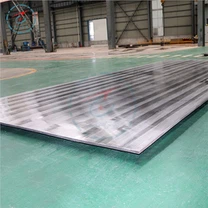
SB-575 N06200 and S30408 Ⅲ are both materials with austenitic structure. Due to the lack of performance in similar material composite panels in the company, the same batch of composite panels with the same furnace number were used for trial production. Following the process flow, a test panel with a specification of (6+45) mm × 920 mm × 920 mm was first produced for first piece process validation.
According to Article 5.4.3 of standard NB/T 47013.3: "The composite board flaw detection probe should use a 2-5 MHz probe, and the effective diameter of the probe chip should be between Φ 10~25 mm. This regulation is reasonable for composite plates made of general carbon steel as the substrate, and the test results are also reliable. However, the material of the composite plate cladding in this batch is SB-575 N06200 nickel alloy, and the substrate is S30408 Ⅲ austenitic stainless steel forging with a thick thickness. Therefore, the probe should be selected taking into account the austenitic stainless steel forging. According to Article 5.7.3.1 of standard NB/T 47013.3, "probes with a nominal frequency of 1-2.5 MHz".
There is a significant difference in the frequency selection of the probe between the two chapters in the standard. Although high-frequency probes have smaller pulse widths, reduced half diffusion angles, better beam directionality, more concentrated energy, and better resolution, when detecting the thickness of austenite, the attenuation of the material increases significantly. Attenuation is closely related to scattering and depends on frequency. Low frequency ultrasonic waves are more likely to penetrate the material, and the attenuation decreases with lower frequency compared to higher frequency. Low frequency probes are beneficial for increasing and expanding the sound path for detection, but there is also a possibility of missing small diameter individual defects. Therefore, it was decided to use a 2.5 MHz Φ 20 mm single crystal straight probe for verification, which can meet the requirements for probe selection in both composite plate and austenitic stainless steel forging detection standards.
After verifying the explosive composite using a 2.5 MHz Φ 20 mm single crystal straight probe, the same reference point position as before the composite was selected, and the same ultrasonic flaw detector and probe were used to detect the composite plate. Perform a 100% scan to detect the bonding status of the substrate and cladding, while also measuring the decrease in bottom wave. The detection surface is the cladding side. Place the probe at the fully bonded part of the composite board, adjust the first bottom echo height to 80% of the full scale of the oscilloscope screen, and use this as the reference sensitivity to perform ultrasonic testing on the board. The results showed no unbound defects, and the bottom waves in some areas were significantly reduced or even disappeared. In the areas where the bottom wave decreases and disappears, adjust the gain to increase the amplitude of the bottom wave to a height equal to the reference sensitivity, and no defect signal reflection is observed. Adding oblique probe detection did not result in defect wave reflection. The center point of the probe is taken as the boundary when the bottom wave rises to 40% of the full screen of the oscilloscope, as shown in the shaded; The results obtained from testing from the substrate side are equivalent to those obtained from testing from the coating side.
Select the same reference point position as before the composite, and record the decrease in the amplitude of the first bottom echo wave and the reference sensitivity wave in each 50 mm × 50 mm test area of the composite board. The decrease in the bottom wave of the entire board is -37~-1 dB, which is an increase of 0-3 dB compared to the decrease before the explosive composite. Therefore, the impact of explosive composite on the bottom wave decrease is not significant. Because the decrease in bottom wave is one of the indicators for evaluating the quality of forgings, it is a separate quality indicator for evaluating material properties.