1.What is UT Testing?
UT = Ultrasonic Testing.
Ultrasonic waves penetrate the metal and reflect signals when encountering defects such as delamination, unbonded areas, voids, or cracks. The flaw detector can then identify any internal issues within the clad plate after the explosive cladding process.
Commonly used probes include 5P probes and 2.5P probes.The 5P probe features high precision and fine resolution, capable of detecting smaller and more subtle unbonded defects. However, it has poor penetration and rapid signal attenuation, making it unable to penetrate thicker plates. It is generally suitable for testing thin clad plates and inspections with strict requirements for bonding interface defects.The 2.5P probe provides strong penetration and can go through thicker plates. Its disadvantage is relatively lower resolution, and it is less sensitive to small defects compared with the 5P probe. It is suitable for thick plates and multi-layer materials.
Our company follows the industry standard practice of using probes based on a thickness threshold of 40mm.
For thin plates (≤40mm), 5P high-frequency probes are used to improve detection accuracy;
for thick plates (>40mm), 2.5P low-frequency probes are applied to ensure sufficient penetration.
UT testing is a type of non-destructive testing (NDT).
It can inspect whether the internal bonding is 100% complete without damaging the plate, making it a key inspection method to ensure the quality and safety of metal composite materials and pressure vessels.
2.Why is 100% UT inspection mandatory for clad plates?
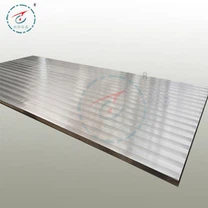
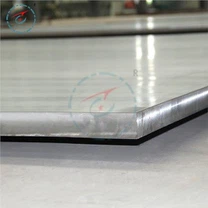
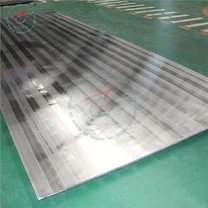
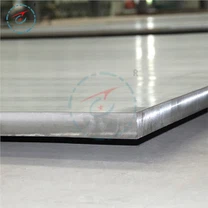
Clad plate consists of a base metal and a cladding metal.
The base metal is usually carbon steel or alloy steel, while the cladding metal is typically titanium, stainless steel, nickel-based alloy, etc.
They are bonded through explosive cladding or roll cladding.
In general, the quality of the bond cannot be assessed by visual inspection alone.
2.1 Check bonding rate to ensure quality Poor bonding may result in:
2.1.1 Local unbonded areas and delamination;
2.1.2 Insufficient bonding strength;
2.1.3 Cracking, leakage and corrosion penetration during service.
2. 2 Extremely high safety requirements for pressure vessels and chemical equipment Clad plates are mostly used in heat exchangers, reactors and storage tanks, which operate under high temperature, high pressure and highly corrosive environments with flammable, explosive or toxic media. Poor bonding may lead to leakage, cladding detachment, explosions and corrosion accidents. Therefore, UT inspection is mandatory in accordance with ASME, GB and ASTM standards.
2.3 100% UT = Class 1 (Highest Grade) Industry classification:
- Class 1: 100% full-plate ultrasonic testing;
- Class 3: sampling inspection by area;
- Class 5: partial inspection.
2.4 Avoid problems in subsequent welding and processing Clad plates produced by explosive or roll bonding are generally subject to cutting, rolling, welding, heat treatment and other processes. Internal unbonded areas may cause cracking, cladding bulging, welding failure, or even scrapping of the entire plate during processing, resulting in economic losses.
100% UT inspection can control risks and avoid economic losses.