
Due to its low alloy density, high specific strength, and good corrosion resistance, titanium alloys are widely used in aviation pressure oil pipelines, corrosion-resistant heat exchangers, and pressure vessel structures. Titanium alloy heat exchangers are mainly used in strong acid environments. Using the excellent corrosion resistance, high specific strength and low density of titanium alloys, the corrosion resistance of heat exchangers can be enhanced, the quality of heat exchangers can be reduced, and the thickness of the heat exchangers can be reduced. The thickness of the tube wall increases the heat transfer effect. At present, the application of titanium alloy heat exchangers is more and more extensive, but titanium alloy welding still has certain difficulties. Through research, titanium tube sheet manufacturers have explored appropriate titanium alloy welding processes and prevention measures for welding defects.
So what are the difficulties in welding titanium tube sheets?
Titanium metal is light in weight, high in strength, and large in specific strength, and it has two crystal structures. Titanium alloy belongs to α+β titanium alloy, which has poor welding performance and uneven distribution of welded joint properties. Its weld strength is slightly lower than that of base metal, and its hardness is higher than that of base metal, but its plasticity is poor. The strength of the heat-affected zone is similar to that of the base metal, the hardness is lower than that of the base metal, but the plasticity is better.
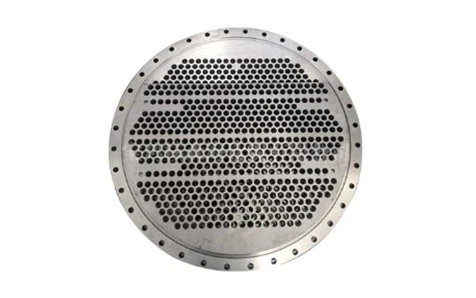
Due to the special thermophysical properties of titanium alloys, high cold cracking tendency, and high chemical activity, a series of problems will occur during the welding of titanium tube sheets.
1. Welding deformation problem
Deformation during welding is inevitable. The elastic modulus of titanium is only half of that of steel, the welding residual deformation is large, and the dimensional accuracy after welding is not guaranteed.
2. Protection problems during nitrogen arc welding
The chemical properties of titanium alloys are extremely active at high temperatures. It starts to absorb at 250 °C, absorbs at 400 °C, and absorbs at 600 °C. Therefore, titanium is most likely to be oxidized during welding, which is easy to cause an increase in weld pores, and will reduce the plasticity and brittleness of the weld, resulting in the generation of welding cracks. Therefore, the area exceeding 250 °C must be protected during welding.
3. Weld porosity problem during hydrogen arc welding
Titanium alloy is lighter in weight, with a density of 4.5g/cm3, which is only 57% of that of steel. Therefore, the buoyancy of the same volume of bubbles in the molten pool during welding is only half of that of the steel molten pool, and the bubbles float up slowly and are formed too late to escape. stomata. In addition, the solubility in the molten pool increases with the decrease of the temperature, and there is a jump at the solidification temperature, which first decreases and then increases. In addition, because the temperature in the middle of the molten pool is higher than that at the edge of the molten pool, the central part of the molten pool is easy to diffuse to the edge of the molten pool. Therefore, the edge of the molten pool has a higher solubility than the middle, so the edge of the molten pool is easily saturated and pores are formed, which is also the reason why most of the pores in the weld of titanium alloys exist on the fusion line.
Baoji Taicheng Clad Metal Materials Co., Ltd is a titanium tube sheets factory, that provides you with a wide range of quality products. At the same time, we are a metal clad tube sheet manufacturer and can provide you with various customized composite tube sheets. Welcome to consult!


