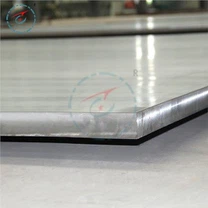
1.What is the Clad Plate Shear Test?
The shear resistance test of clad plates adopts professional dedicated testing equipment to apply lateral shear force on the bonding interface between the base material (low carbon steel / low alloy steel) and the cladding layer (stainless steel, titanium, nickel and other materials). It simulates the interaction of two metals under actual service conditions to test the interfacial bonding strength, and finally evaluates the service performance of clad plates based on the test results.
The core principle lies in lateral dislocation shearing of the bonding interface. Different from the conventional tensile separation in vertical direction, the shear test produces relative lateral slippage between the base layer and cladding layer. By measuring the maximum interlayer force, the interfacial shear strength is calculated, which directly reflects the interfacial bonding compactness and comprehensive quality of clad plates.
2. Core Significance of the Shear Test
The core risk of clad plates is delamination between the base layer and the cladding layer, which will cause equipment pressure failure, medium corrosion and leakage, and seriously shorten service life. The shear resistance test is designed to eliminate such risks, with the specific values as follows:
2.1 Bonding strength verification
To verify that the bonding quality of clad plates meets industrial standards and project specifications, ensuring no separation occurs between the two metals during processing and service.
2.2 Guarantee of processing safety
Effectively prevent delamination, bulging and other defects during forming processes such as rolling, bending and stamping.
2.3 Long-term service stability
Verify that the interfacial bonding strength remains qualified under actual working conditions including post-weld heat treatment (PWHT), high temperature and high pressure, so as to extend the service life of equipment.
2.4 Compliance with standard requirements
As a mandatory inspection item specified by international and domestic standards such as ASME and GB, it serves as essential documentation for factory delivery, export supply (e.g. EN 10204 3.2 certification) and third-party inspection (BV / TUV / LR).
3. Test Principle and Procedure
3.1 Test Principle With a universal testing machine and special shear fixture, the standard clad plate specimen is fixed. Reverse lateral force is applied separately to the base layer and the cladding layer, causing shear deformation at the bonding interface until interface failure occurs or the specified standard strength is reached. The maximum shear force recorded by the equipment, combined with specimen dimensions, is used to calculate the interfacial shear strength (Unit: MPa).
Qualification Judgment: If shear failure occurs in the base metal or cladding base material, the interfacial bonding strength is superior to the base material, and the product is judged qualified. If fracture occurs directly along the bonding interface, the bonding quality is insufficient, and the product is judged unqualified.
3.2 Standard Test Procedure
3.2.1 Sampling: Cut standard specimens from clad plates in accordance with relevant standards and project requirements to ensure the interface is free of damage and inclusions.
3.2.2 Clamping: Accurately mount the specimen into the dedicated shear fixture, fix the base layer and fasten the cladding layer, and ensure the force direction is perpendicular to the bonding interface.
3.2.3 Force Loading: Start the universal testing machine, apply lateral shear force at a constant speed, and record force changes in real time.
3.2.4 Calculation: Calculate the interfacial shear strength based on test data and judge qualification by comparing with standard requirements.
3.2.5 Documentation: Issue a formal test report with detailed information of specimens, test data and judgment results, which serves as the core quality certification basis for clad plates.