1 Products Description
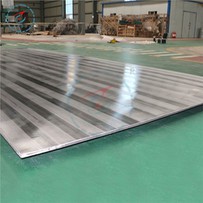
With the increase of the charge, the wavelength and amplitude will also increase. When the charge amount is fixed, the wavelength and amplitude of the interface waveform obtained by different processes first increase and then decrease with the increase of the distance between the SS304 Stainless Steel Clad Steel Plate for Industry and the substrate. The bonding strength of the interface is positively correlated with wavelength and amplitude at first, and then negatively correlated to a certain extent. When the wavelength of the interface wave is the same, the smaller the amplitude is, the higher the bonding strength of the interface is. The influence of spacing on the joint surface is much less than that of the charge weight. For the thickness of the cladding plate (SUS304) is 3mm, and the spacing of 8mm is a good value. The difference of charge weight has little influence on the optimal spacing value.
2 Development of explosive welding
The explosive welding method was first proposed by L. RCa in 1944. In an explosive explosion test, Carl found that two round brass sheets with a diameter of about 1 inch and a thickness of 0.035 inch were welded together, which was caused by the work done by the detonation products. Therefore, he proposed the research topic of welding metal using explosion and ultrasonic technology. More than a decade later, V. Philipchuk of the United States introduced explosive welding technology to industrial engineering for the first time. As the former Soviet Union, Germany, Britain and other countries carried out systematic research on explosive welding theory and related technologies, explosive welding theory and technology are becoming more and more mature. The research on explosive welding started late in China, starting from the 1960s.
In 1968, Chen Huojin and others of Dalian Shipyard successfully tested the first explosive-clad plate in China. Subsequently, the West Institute of Nonferrous Metals carried out research and production on the preparation process of explosive welding composites, and the Institute of Mechanics of the Chinese Academy of Sciences of the Dalian University of Technology also carried out research on the impact mechanics of explosive welding materials. As a frontier scientific research technology, explosive welding has become a very important metal processing method in today's industry. For example, the processing of special equipment such as agitators and reaction towers in chemical plants, seawater desalination devices in seawater desalination plants, superalloys used for the inner wall of gun tubes in the military industry, and aluminum double-layer pressure pipe liners in the nuclear industry requires explosive welding technology.


3Study on drug distribution mode
Explosive is an indispensable part of explosive welding, which provides the required energy. How to place explosives is a very important problem. The traditional way to arrange explosives is to lay the explosives on the composite board with equal thickness. Theoretically, after the detonation of the explosive, the detonation wave will start to accelerate and eventually reach a stable detonation velocity. After the detonation process is stable, the load applied by the explosion force to drive the movement of the clad plate will also become stable, and the collision speed between the base plate and the clad plate will not change. Therefore, after the detonation wave has spread for a certain distance, the wave shape of the bonding interface between the clad plate and the base plate will show a stable amplitude and wavelength. However, this is not the case in practice. In the case of the same thickness of explosives, even if the detonation state is stable, SS304 Stainless Steel Clad Steel Plate for Industry interface waveform will not be stable, and the amplitude and wavelength will only gradually increase along the propagation direction of the detonation wave. For this phenomenon, it is considered through analysis that it is mainly the result of the combined action of the detonation load acting on the cladding plate and the strong vibration of the "plate to be welded" produced by the collision of the base cladding plate. Literature research shows that the bonding quality of composite plates obtained by an unequal thickness distribution process is better than that of the traditional equal thickness distribution process. When the unequal thickness explosive distribution process is adopted, it can effectively ensure that the load exerted on the cladding plate by the explosive during the detonation process remains uniform and unchanged, so that the collision speed between the cladding plate and the substrate tends to be stable, which can well prevent defects such as cavities at the welding interface caused by large changes in the collision speed of the plates, and is very helpful to improve the bonding quality of the cladding plate and the substrate.
4 Introduction to explosive welding window
For explosive welding, the first problem to be solved is how to correctly select the process parameters, because the selection of the process parameters for explosive welding is a very important link, and different parameters have a very important impact on the characteristics of the composite materials obtained by explosive welding, which is directly related to the waveform of the composite plate bonding interface and related mechanical properties. Therefore, the process of selecting process parameters should be reasonable and prudent. It is generally believed that high-quality explosive welding needs to meet the following requirements.
(1) The reentry jet must be formed during welding to make the interface self-clean and expose the fresh surface.
(2) Forming fine and uniform wavy interface.
(3) the bonding interface does not appear over the melting phenomenon because of the complex process of explosive welding and many influencing factors, the current theoretical research on explosive welding is not perfect. There is no complete theory for the important issues such as the flow law of metal under high temperature and pressure and the dynamic strength of materials under high-speed impact. Therefore, there is no accurate calculation method for a series of parameters of explosive welding, and only a reasonable range can be determined through the relevant formula, that is, the "explosive welding window". Although taking a value in the window can ensure the success of explosive welding to a certain extent, the quality of composite materials varies greatly. Therefore, it is very important to choose among the many seemingly reasonable parameters in the explosive welding window. This requires us to explore the change law of composite material quality with the parameters in the explosive welding window, which is also the focus of this paper. Parameters of explosive welding window include: collision point moving speed Ⅴ ε, Cladding plate collision velocity V, and collision angle between cladding plate and substrate β。 The controllable process parameters include the type of explosive, the nature of the explosive (detonation velocity Vd, density p), the ratio of charge mass per unit area to the weight of cladding plate per unit area R, and the installation distance between cladding plate and substrate Explosives substrate.
Hot Tags: ss304 stainless steel clad steel plate for industry, China, manufacturers, suppliers, factory, customized, wholesale, buy, price, quality, quotation, pricelist, in stock, for sale, made in China, Bimetallic Copper Clad Steel Plate for Industry, copper clad steel conductor, Stainless Steel Clad Steel Plate tube sheet, cladded stainless steel, Stainless Steel Clad Steel Plate for Heat exchanger, Cladded Copper Stainless Steel Plate for Heat exchanger