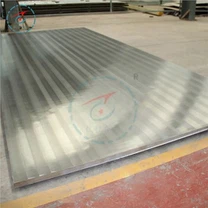
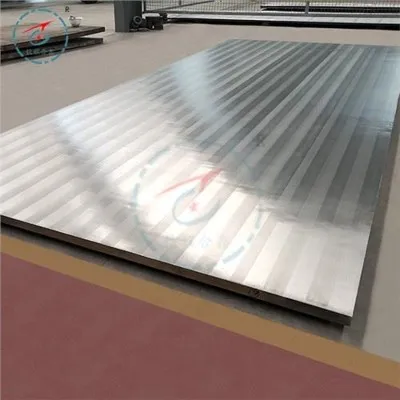
In order to obtain a larger area of titanium clad steel plate, an effective way is to use the explosion + rolling method, that is, the clad slab is explosively welded first, and then hot-rolled on a rolling mill to obtain the required thickness and large plate width. titanium steel clad plate. Due to the differences in physical and mechanical properties such as melting point, thermal conductivity, and deformation resistance of the bimetallic titanium and steel that make up the composite plate, the rolling process is much more complicated than that of a single material.
Titanium-steel clad slabs are heat-treated before rolling to eliminate the hardening and strengthening caused by explosive welding, and at the same time improve the internal structure so that the billet has sufficient plasticity and low deformation resistance to facilitate subsequent rolling.
The cladding layer of titanium steel clad sheet is titanium, which is a chemically active metal that is easy to react with elements such as C, H, O, and N. When the heating temperature of the titanium material rises above 500°C, the oxide film on the titanium surface becomes porous and easy to peel off, and oxygen begins to infiltrate into the matrix through the small pores, and forms the so-called gettering within a certain thickness range on the surface of the titanium layer. Layer, this getter layer significantly reduces the plasticity of the titanium surface layer of the slab, and also increases the degree of uneven deformation in subsequent rolling. In addition, the hydrogen absorption phenomenon cannot be ignored when heating. When titanium is above 400 ° C, a large amount of hydrogen is absorbed. When the hydrogen content reaches a certain level, the hydride precipitation phase TiH2 will be precipitated along the grain boundary or from the grain boundary to the intragranular direction.

In order to prevent the above-mentioned harmful gas pollution, it is relatively ideal to choose induction furnace and electric furnace, especially induction furnace, which has high power, fast heating speed and short overall heating time, which can effectively reduce the gas absorption phenomenon on the titanium surface.
The selection of heating temperature and final rolling temperature should take into account the heating characteristics of titanium and steel single-body hot rolling. In addition, as a bimetallic composite material, the interface bonding strength is also affected by the heating temperature, which cannot be ignored.
The heating time should not be too long or too short. If it is too long, it will intensify the oxidation of the titanium layer on the surface, hydrogen embrittlement and deteriorate the bonding performance of the interface; if it is too short, there may be a temperature difference in the slab, and the deformation resistance will be small when the temperature is high during rolling. , where the plasticity is good but the temperature is low, the deformation resistance is large and the plasticity is poor, resulting in uneven deformation. The principle of setting the time is based on the material being thoroughly burned, and the time should not be too long or too short. In addition, from the perspective of avoiding the gas absorption phenomenon of the titanium layer and the excessive precipitation of intermetallic compounds, in order to reduce the overall heating time of titanium steel, the form of hot charging furnace can be adopted, that is, the billet is put into the furnace after the furnace chamber reaches temperature.
Titanium-steel metal composite plates have their unique performance advantages, which will inevitably provide a better choice for human development, and will also increase their popularity in high-tech, military, civilian products and other industries. Baoji Taicheng Clad Metal Materials Co., Ltd, as a professional titanium clad steel plate manufacturer, we have high quality service and competitive price. Welcome to consult!