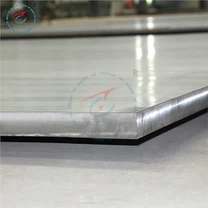
Metal composite panels have been widely used in various industries such as chemical, petroleum, petrochemical, light industry, food and medicine for anti-corrosion and product cleaning equipment. In practice, it has been proven that metal composite panels are an ideal anti-corrosion engineering material. There are three production methods for metal composite plates - explosion method, rolling method, and explosion rolling method. From the perspective of shear strength, the composite plate produced by explosion method has the highest shear strength, reaching 290MPa (the standard is 210MPa).
At present, composite plates of stainless steel, titanium, copper, aluminum, nickel, E, steel (specially resistant to salt brine corrosion) and carbon steel, low-alloy steel can be produced domestically. The board width can reach 1.7m, and the board length can reach 8m (some composite boards can reach 1.9m in width). The production of composite panels can greatly save the consumption of precious metals and significantly reduce equipment investment in engineering, playing a positive role in conserving resources and reducing engineering construction costs for the country and construction parties. 2. Several issues to be noted in the application of metal composite plates.
Several issues to be noted in the application of metal composite plates
(1) Forming and cutting
The forming of metal composite plates should be carried out using cold processing methods as much as possible, which can avoid a decrease in the corrosion resistance of the composite materials, especially stainless steel composite plates. There is no problem with metal composite plates when cold working to roll simplified shapes, but when spinning and pressing the head, attention should be paid to the cold work hardening of ferritic stainless steel composite plates during the pressing process. For example, 0Cr13A1+16MnR composite plates. During the pressing process, when the bottom of the head is pressed, it is subjected to air cooling annealing treatment at 830+10 ℃ for 15 minutes (furnace temperature ≤ 400 ℃, temperature rise of 150 ℃/h), and then the edges of the head are spun. Otherwise, the head is prone to brittle cracks or even fractures during edge spinning. It is best to use a shearing machine for cutting. If the plate thickness is thick, plasma cutting can be used, or gas cutting or oxygen assisted cutting can be used. When cutting, attention should be paid to cutting from the base surface. Start cutting. The cutting edge of the hot cut composite board must be carefully cleaned before welding.
(2) Heating up
When the thickness of the composite board base layer is large (8>2.5% D;, D is the inner diameter of the circle) or when hot pressing or heat treatment is required for the head, the atmosphere inside the furnace must be strictly controlled. It is best to use electric heating method, such as using coal, natural gas or gas heating furnace. The lower the sulfur content inside the furnace, the better. For certain materials with special requirements for sulfur content, it must be indicated on the drawing. On the premise of ensuring the performance of the composite board material, the insulation time of the material in the furnace should not be too long. According to the experience of the composite board production factory, the insulation time should not exceed 25 minutes and the heating frequency should not exceed 3 times. (3) The welding sequence for welding metal composite plates is: first weld the base layer, then weld the transition layer, and finally weld the cladding layer. The transition layer is an essential process during welding, otherwise weld cracks are prone to occur after welding. In addition, when welding transition layers and cladding, attention should be paid to using small-diameter welding rods, small specifications, straight welds, and multi pass welding. Other welding processes can be carried out based on the manufacturer's experience or the welding process provided free of charge by the composite plate manufacturer. During the welding process, attention should be paid to cleaning each layer of the weld seam and promptly removing impurities such as oxide skin to ensure welding quality. Metal composite panels have been widely used and are an ideal engineering material that saves resources and investment. As long as the processing method is paid attention to in application, and the technical parameters and information provided by the composite panel manufacturer are referenced, satisfactory results can be obtained.