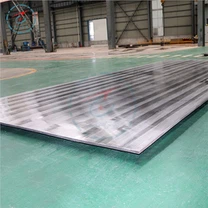
The preparation methods of titanium steel composite plates mainly include explosion method, explosion+rolling method, rolling method, and diffusion method. The diffusion method for preparing titanium steel composite plates has a longer composite time and insufficient interfacial strength, making it unsuitable for industrial production. The domestic production mainly adopts the explosion method, which has a simple process, mature technology, and high composite interface strength of the product. However, it has the disadvantages of high noise pollution to the environment and limited preparation size. Most foreign countries use rolling method to produce titanium steel composite plates, which not only has controllable plate width and size specifications, but also has stable and pure composite interface performance, effectively avoiding the above-mentioned problems. In the future, it will gradually replace the explosion method as the mainstream method for preparing titanium steel composite plates.
The preparation of composite plates by rolling method can be divided into direct rolling method and vacuum rolling method. When using direct rolling method to prepare titanium steel composite plates, the pressure between the surfaces of the composite metal is usually above 105Pa. At this time, the titanium composite material will inevitably undergo strong reaction with oxygen, which hinders the metallurgical bonding at the interface and leads to composite failure. Therefore, vacuum rolling method must be used [10]. In actual production, titanium steel composite billets are often prepared by symmetrically assembling the billets and vacuum pumping the reserved pores at the welding seams of the billets, and then subjected to heating and rolling. The selection of vacuum degree is the key to ensuring the cleanliness of the surface of the titanium steel to be composite metal during the heating and rolling process. When the vacuum is too high, there is more residual air in the composite billet, which pollutes the composite interface; When the vacuum is too low, the vacuum extraction rate is slow, which affects production efficiency. At present, most research is focused on the hot rolling process of titanium steel composite plates, with little attention paid to the effect of vacuum degree on the microstructure and properties of the preparation process of rolled titanium steel composite plates. Therefore, this article analyzes the interface microstructure and oxidation behavior of rolled titanium steel composite plates under different vacuum degrees, combined with microhardness and shear strength, to provide a reasonable vacuum degree for preparing titanium steel composite billets, which has important guiding significance for the industrial production of titanium steel composite plates using rolling methods.
Q345R steel is used as the base metal, and TA2 industrial pure titanium is used as the composite material. Its specific chemical composition is shown in Table 1

The preparation of titanium steel composite plates in this experiment includes the following processes: billet preparation, surface treatment, isolation agent coating, billet sealing and welding, and heating and rolling. Processed into substrate Q345R with dimensions of 180 mm × 130 mm × 40mm and composite TA2 with dimensions of 180 mm × 130 mm × 10 mm using wire cutting; Polish the surface of the composite metal until the fresh metal is completely exposed, and then wipe it with alcohol to remove surface oil stains, oxidation and other impurities; Before assembling, it is necessary to evenly coat the surface between the titanium composite materials with a release agent; When assembling the billet, the groove method is used, which is to assemble the billet in a symmetrical form by covering the outer substrate with steel and the inner layer with composite titanium; Using manual arc welding to seal and weld around the substrate, leaving a gap for vacuum extraction, to form a titanium steel composite billet. Prepare three sets of titanium steel composite billets with the same size, and use a vacuum molecular pump to extract vacuum from the inside of the composite billets, so that the vacuum degrees inside the billets are 1, 0.1, and 0.01 Pa, respectively, and record them as samples 1 #, 2 #, and 3 #, respectively. Place the assembled titanium steel composite billet into a heating furnace and heat it at a temperature of 930 ℃.
After 2 hours of insulation, rolling is carried out with a total reduction rate of 80% and a rolling speed of 0.3m/s. After rolling, it is air cooled to room temperature. Metallographic samples were taken and polished from the composite interface and the bonding position of the titanium composite layer on the titanium steel composite plate. Corrosion was carried out using a 4% nitric acid alcohol solution, and the microstructure of the sample was observed and analyzed by EDS energy spectrum using a scanning electron microscope. Hardness analysis was performed at different positions of the sample using a Vickers hardness tester, and mechanical properties of the titanium steel composite plate were tested using a universal tensile machine.